10 Best Soundbars of 2026, Researched & Ranked
Television speakers keep getting worse, because flat panels leave nowhere to put them. That single fact explains why soundbars now outsell every other category of home audio. Our top pick is the Sonos Arc Ultra, which throws a wider and more believable Dolby Atmos soundstage from one cabinet than anything else that arrives in a single box.
Ranked below are ten bars judged on film performance, dialogue handling, what actually ships in the carton and how each one physically fits a real living room. They run from complete surround systems with rear speakers through to compact bars built for smaller screens, with a buying guide explaining the channel numbers.
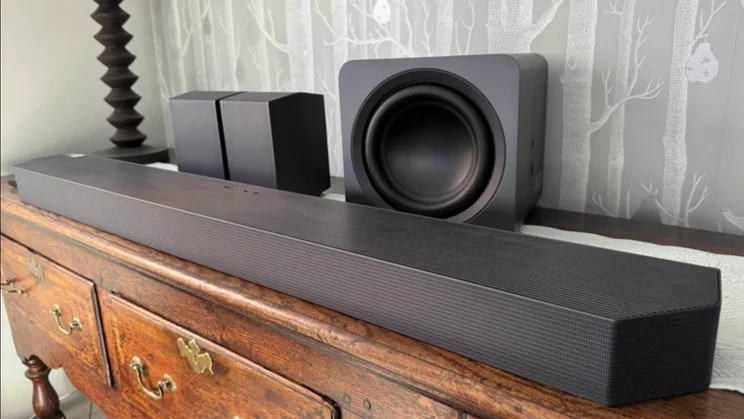

- Movie impact: Nine channels and four height drivers throw the widest bubble here
- Dialogue clarity: Speech Enhancement offers four levels rather than a single blunt switch
- Setup and inputs: Trueplay calibration tunes the bar to your room in a couple of minutes
- Music listening: The Sound Motion woofer gives real weight with no separate box needed
- Wireless streaming: Wi-Fi multiroom, AirPlay and Bluetooth all arrive as standard equipment
- Surround expansion: Sonos Sub and Era speakers slot in later without replacing the bar
- No subwoofer: No subwoofer is included, so the deepest effects need one added
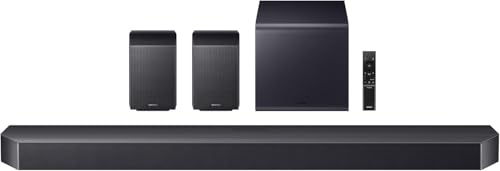
- Movie impact: Eleven channels with four height drivers and genuine rear speakers behind you
- Dialogue clarity: A dedicated centre channel keeps speech anchored to the screen properly
- Setup and inputs: SpaceFit calibration adjusts output to the room without any manual fiddling
- Music listening: Q-Symphony pairs it with a Samsung television rather than muting the set
- Wireless streaming: Wireless connection to the subwoofer and both rear speakers keeps cabling minimal
- Surround expansion: Nothing further needs buying, since the surround package is already complete
- Rear power: The rear speakers still need mains sockets on the back wall

- Movie impact: Thirteen drivers with beam tweeters that place effects around the seating position
- Dialogue clarity: Voice Zoom 3 lifts speech out of a busy mix without thinning it
- Setup and inputs: Spatial mapping measures the room and generates phantom speakers from it
- Music listening: Handles music with more restraint than most effects-focused rivals manage
- Wireless streaming: Wireless subwoofer arrives in the box and pairs without any setup
- Rears cost extra: Genuine rear speakers are an optional purchase rather than included

- Movie impact: Compact single bar that still generates convincing height from ceiling reflections
- Dialogue clarity: A.I. Dialogue Mode separates speech from effects better than anything here
- Setup and inputs: One cable to the television and it works, with no calibration routine
- Music listening: Handles music sensibly, which many dialogue-focused bars manage rather poorly
- Wireless streaming: Bluetooth, AirPlay and Chromecast are all built in from the start
- No bass module: Deep effects need the separate bass module, sold on its own
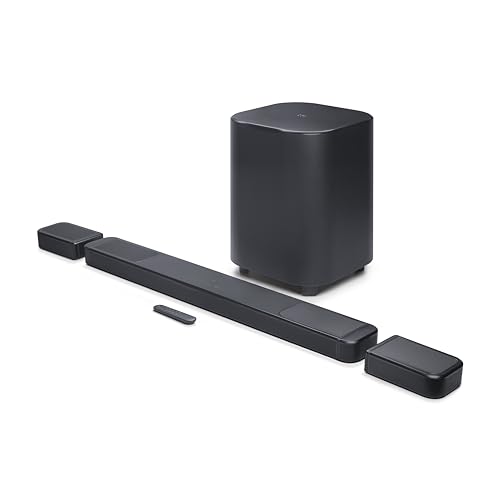
- Movie impact: Eleven channels once the end caps are detached and placed behind you
- Dialogue clarity: A firm centre channel that keeps dialogue distinct during action scenes
- Setup and inputs: MultiBeam calibration runs automatically whenever the speakers are reattached
- Music listening: Music playback stays composed with the surrounds docked back onto the bar
- Wireless streaming: Chromecast, AirPlay and multiroom support all included as standard
- Recharging: Detached surrounds run on batteries and need docking to recharge

- Movie impact: A wireless subwoofer arrives included, which most bars near this level omit
- Dialogue clarity: Clear Voice lifts speech without the boxy tone cheaper processing produces
- Setup and inputs: Setup runs to one cable, and the subwoofer pairs itself on power-up
- Music listening: Yamaha's decades of amplifier work show in how naturally music plays
- Virtual height: Height effects are simulated, so overhead cues stay fairly subtle

- Movie impact: Atmos decoding and a wireless subwoofer inside a bar under fifteen inches
- Dialogue clarity: VoiceAdjust raises dialogue independently, which suits late-night viewing well
- Setup and inputs: Fits beneath a smaller television where full-width bars simply will not sit
- Music listening: Chromecast and AirPlay built in, so streaming needs no extra hardware
- Narrow soundstage: The narrow cabinet cannot spread sound as wide as bigger bars
- Modest volume: It runs short of headroom in genuinely large open-plan rooms

- Movie impact: Nine channels and five height drivers, the most overhead coverage listed here
- Dialogue clarity: Centre-channel handling keeps dialogue clear even through busy action sequences
- Setup and inputs: WOW Orchestra combines the bar with an LG television instead of silencing it
- Music listening: Rear speakers with their own upfiring drivers arrive in the box
- Wireless streaming: Wireless links throughout the system, and calibration runs itself automatically
- Brand tie-in: The headline features only work fully alongside a recent LG television
- Bulk: The full package takes up considerably more room than a single bar
- Menus: Its app is slower to navigate than rivals from the audio specialists

- Movie impact: Genuine upfiring drivers rather than simulation, unusual this far down the market
- Dialogue clarity: A dedicated centre channel keeps speech anchored where cheaper bars smear it
- Setup and inputs: HDMI eARC included, so one cable handles both sound and control
- Music listening: Seven equaliser modes cover films, music and late-night listening properly
- Wireless streaming: Bluetooth streaming works reliably for background music between films
- Modest bass: Its subwoofer lacks the depth the pricier systems here produce
- Plain app: App control is basic, and the remote does most of the work

- Movie impact: Atmos and DTS:X decoding at a level where most rivals offer neither
- Dialogue clarity: Speech stays intelligible thanks to sensible processing rather than heavy boosting
- Setup and inputs: One HDMI cable and it works, with wall-mount hardware supplied in the box
- Music listening: Bluetooth handles casual music duty without needing the television switched on
- Wireless streaming: Streaming from a phone works without opening any additional application first
- Virtual only: Height comes from processing, so overhead effects stay understated
- Small drivers: Its compact drivers thin out when pushed to higher volumes
- Basic remote: The supplied remote feels cheap next to everything above it
All Ten Soundbars in Detail
Each entry covers film performance, dialogue handling and exactly what arrives in the box, since that varies enormously here.
#1 · Editor's Choice
Sonos Arc Ultra Dolby Atmos Soundbar
Sonos built the Arc Ultra around a new woofer design, and the result is a single bar that fills a room without a separate box on the floor. Nine channels and four upfiring drivers produce the most convincing overhead effect of anything here that arrives in one carton. Speech Enhancement runs across four levels, which is far more useful than the on-off switch most rivals offer. No subwoofer is included, though, so the very lowest effects want the matching Sub added later. As a one-purchase upgrade, nothing else is this complete.
The verdict: The most convincing single-bar Atmos performance available, with a subwoofer sold separately.
#2 · Runner-Up
Samsung HW-Q990F Dolby Atmos Soundbar System
Opening one carton and finding a bar, a subwoofer and two rear speakers changes what a soundbar purchase means. Eleven channels with four height drivers produce genuine surround rather than a clever simulation of it, and effects genuinely travel behind your head. SpaceFit calibration handles room correction automatically. The rear speakers connect wirelessly to the bar but still need mains power, so plan for two sockets behind the sofa. For anyone who wants a complete cinema without assembling separates, this is the shortest route there.
The verdict: A complete surround system in one box, provided you can power the rear speakers.
#3 · Best Spatial Audio
Sony Bravia Theater Bar 9 Soundbar
Sony's approach differs from everyone else here. Rather than firing sound upward and hoping the ceiling cooperates, spatial mapping measures your room and synthesises phantom speakers around the seating position. In practice that means effects arrive from places where no driver exists. Thirteen speakers do the work, with a wireless subwoofer included. Rear speakers cost extra, unlike the Samsung above, which matters if you want physical surround from the outset. Owners of a Sony television gain a further trick, since the set becomes a centre channel.
The verdict: The cleverest processing here, and the pick if adding rear speakers is not for you.
#4 · Clearest Dialogue
Bose Smart Soundbar with Dolby Atmos
Dialogue is the reason most people replace their television speakers, and Bose targeted exactly that. A.I. Dialogue Mode separates voices from effects intelligently, and the difference is obvious the first time a whispered scene arrives. TrueSpace upmixing gives older stereo material a sense of height too. The single-bar design keeps installation to one cable. Bass is where it gives ground, since no subwoofer is included and the separate module costs extra. For dialogue-led viewing in a normal living room, it is the clearest option ranked here.
The verdict: The best answer to muffled television dialogue, though bass needs a separate module.
#5 · Best Detachable Rears
JBL Bar 1300X Soundbar with Detachable Speakers
The clever part sits at each end of the bar. Pull the caps off and they become battery-powered wireless rear speakers; push them back and you have a tidy single bar again. That flexibility suits households that want surround on film nights but not permanently. Eleven channels and a wireless subwoofer put it in the same class as the Samsung, and calibration reruns itself whenever you reattach. Batteries do need recharging, so plan around a docking routine. Few designs solve the surround compromise this neatly.
The verdict: Surround when you want it and a tidy bar when you do not, at a battery-management cost.
#6 · Best Budget Atmos
Yamaha SR-B40A Soundbar with Wireless Subwoofer
Yamaha has been designing amplifiers for far longer than soundbars have existed, and that heritage shows in how this one handles music. A wireless subwoofer is included, which most rivals at this level quietly leave out, and Clear Voice lifts dialogue without the boxy artefacts cheap processing introduces. Height effects are virtual rather than produced by upfiring drivers, so overhead cues stay subtle compared with the Sonos. Judged as an affordable upgrade over television speakers that also respects music, it is the sensible pick.
The verdict: The best-sounding affordable bar here, with genuine bass and only simulated height.
#7 · Smallest Footprint
Polk Audio MagniFi Mini AX Compact Soundbar
Bar width is the specification nobody checks until the box arrives, and at 14.5 inches this one fits consoles where a full-size bar overhangs badly. Polk still fitted Atmos decoding and shipped a wireless subwoofer alongside it. VoiceAdjust raises dialogue on its own, which is handy for late viewing at low volume. Physics limits what a narrow cabinet can spread, so the soundstage is tighter than the Sonos or Samsung, and it runs out of headroom in a large open-plan space. Beneath a smaller television, it makes real sense.
The verdict: The right answer for small rooms and smaller televisions, within honest volume limits.
#8 · Best for LG TVs
LG S95TR Dolby Atmos Soundbar System
Five height channels is more overhead coverage than anything else ranked here, and with rear speakers included the effect is genuinely enveloping. WOW Orchestra is the real hook for LG television owners, combining the set's own speakers with the bar rather than muting them, which lifts the soundstage upward toward the screen. Buyers without an LG set lose that advantage and should weigh the Samsung instead. The full package occupies real space, and the app trails those from the audio specialists.
The verdict: Unbeatable overhead coverage for LG television owners, and less compelling without one.
#9 · Best Cheap Atmos
Hisense AX3120Q Soundbar with Wireless Subwoofer
Real upfiring drivers at this level are rare, and that is what separates this bar from the crowd of cheap 2.1 systems. A dedicated centre channel anchors dialogue properly rather than smearing it across the front, and eARC means one cable does everything. The included subwoofer adds welcome weight, if not the depth the Samsung or LG systems reach. App control is basic and you will mostly use the remote. As a first Atmos system on a tight outlay, it covers the fundamentals honestly.
The verdict: Real height drivers and a subwoofer for very little, with predictable bass limits.
#10 · Best Value Pick
Vizio 2.1 Soundbar with Wireless Subwoofer
Value is the entire argument, and it is a strong one. Atmos and DTS:X decoding plus a wireless subwoofer, for less than the cost of a couple of cinema trips, changes television audio far more than most upgrades at any level. Height is processed rather than fired upward, so overhead cues stay understated next to the Hisense. Push the volume hard and the compact drivers thin out. Judged as the point where replacing television speakers stops being a financial decision, it earns its place easily.
The verdict: The cheapest bar here worth owning, provided expectations about height stay realistic.
How We Researched and Scored These Soundbars
This ranking is built from published testing by hi-fi specialists and consumer titles, which we cross-checked against manufacturer specifications and live retail listings. No listening room of our own sits behind it. Sixteen bars entered the shortlist and ten survived, each confirmed as currently sold rather than discontinued.
- Film performance: how convincingly each bar creates a soundstage, weighted toward genuine drivers over simulated effects.
- Dialogue handling: the specific technology used to lift speech, since muffled dialogue drives most soundbar purchases.
- What arrives in the box: whether a subwoofer and rear speakers are included or sold separately afterwards.
- Physical fit: bar width against typical television sizes, plus the sockets and space a full system demands.
- Music ability: how each performs on stereo material, which many effects-focused bars handle poorly.
Film performance and dialogue handling carried roughly thirty per cent each, with box contents and physical fit at about twenty per cent apiece. Music ability broke ties. Four models were dropped because the listings resolved to discontinued or refurbished stock rather than current units.
One integrity note: no manufacturer had input into this ranking, and no placement was paid for.
What to Look For in a Soundbar
Channel notation looks intimidating and decodes simply. The first number counts speakers around you, the second counts subwoofers, and the third counts height channels. A 5.1.2 system therefore has five surrounding speakers, one subwoofer and two height drivers. More is not automatically better, because a bar cramming eleven channels into one cabinet without rear speakers is still throwing everything from the front.
Whether a subwoofer is included changes the real cost more than any other factor. Two of the highest-ranked bars here ship without one, while several cheaper systems include a subwoofer and rear speakers together. Read the box contents before comparing anything, or a bargain turns expensive once you complete the system.
Height effects come in two forms, and the difference is audible. Upfiring drivers physically bounce sound off your ceiling, which needs a flat ceiling of reasonable height to work. Virtual height is processing that mimics the effect through the front drivers. Real drivers win in a suitable room, while virtual processing is more consistent in an awkward one.
Check the connection and the width before you buy. HDMI eARC carries lossless formats and lets one remote control everything, while optical cannot pass the higher-quality Atmos streams at all. Bar width matters too: sit a 46 inch bar beneath a 43 inch television and it will overhang at both ends.
Who Needs a Soundbar (and Who Really Does Not)
Anyone straining to catch dialogue on a modern television is the core audience, and that describes a great many people. Flat panels have almost no room inside for speakers, so voices get thin and effects get shouty. The Bose bar targets exactly that problem, and the Sonos, Sony and Samsung systems all address it with dedicated centre channels.
Film enthusiasts with space should look at the complete systems. The Samsung and LG packages arrive with rear speakers and a subwoofer, which produces genuine surround rather than a simulation of it. The JBL suits households wanting both options, since its surrounds detach for film nights and dock away afterwards.
Renters, apartment dwellers and anyone with a smaller television are better served further down. The Polk fits where full-width bars cannot, and the Vizio and Hisense options transform television audio for very little outlay.
Who should skip a soundbar? Anyone who already owns a stereo amplifier and decent speakers, since a proper two-channel system beats most bars on music and can handle films through a receiver. Anyone in a flat with thin walls should also think carefully, because subwoofers travel through floors far better than dialogue ever does.
Test Results
| Soundbar | Channels | Subwoofer | Rear speakers | Height | Overall |
|---|---|---|---|---|---|
| Sonos Arc Ultra Dolby Atmos Soundbar | 9.1.4 | Not included | Optional | 4 upfiring drivers | 9.8 |
| Samsung HW-Q990F Dolby Atmos Soundbar System | 11.1.4 | Included | Included | 4 upfiring drivers | 9.7 |
| Sony Bravia Theater Bar 9 Soundbar | 7.0.2 plus mapping | Included | Optional | Beam tweeters | 9.4 |
| Bose Smart Soundbar with Dolby Atmos | 5.0.2 virtualised | Optional module | Optional | Virtual processing | 9.2 |
| JBL Bar 1300X Soundbar with Detachable Speakers | 11.1.4 | Included | Detachable | 4 upfiring drivers | 9.1 |
| Yamaha SR-B40A Soundbar with Wireless Subwoofer | 2.1 virtual height | Included | Not available | Virtual processing | 8.8 |
| Polk Audio MagniFi Mini AX Compact Soundbar | 5.1.2 virtualised | Included | Not available | Virtual processing | 8.6 |
| LG S95TR Dolby Atmos Soundbar System | 9.1.5 | Included | Included | 5 upfiring drivers | 8.9 |
| Hisense AX3120Q Soundbar with Wireless Subwoofer | 3.1.2 | Included | Not available | 2 upfiring drivers | 8.4 |
| Vizio 2.1 Soundbar with Wireless Subwoofer | 2.1 virtual height | Included | Not available | Virtual processing | 8.1 |
Frequently Asked Questions
Do I need a subwoofer with a soundbar
Not always, and two of the best bars here ship without one. A subwoofer adds the low frequencies you feel rather than hear, which matters for film effects and much less for dialogue or television drama. Bars with larger cabinets, like the Sonos, produce respectable bass alone. If your viewing is mostly action films, add one.
What does Dolby Atmos actually add on a soundbar
It adds a height dimension, so sound can appear to come from above rather than only ahead. Bars achieve this two ways: upfiring drivers that bounce sound off the ceiling, or processing that simulates the effect. Genuine drivers work better in rooms with flat ceilings of normal height, while processing is more consistent in awkward spaces.
Is HDMI eARC better than optical for a soundbar
Yes, and meaningfully so for anyone buying an Atmos bar. Optical cables cannot carry the higher-bandwidth formats, so an optical connection quietly downgrades what you hear. HDMI eARC carries the full stream and lets one remote control volume across both devices. Use optical only when your television has no eARC port available.
Can a soundbar replace a full surround sound system
Partly, and it depends what you mean by replace. Bars with genuine rear speakers, like the Samsung and LG systems here, produce real surround because sound actually originates behind you. Single bars simulate that effect, and while the better ones are convincing, no processing fully matches a speaker physically placed behind your head.
Does the soundbar need to match the width of my TV
It should not exceed it, though matching exactly matters less than people assume. A bar wider than the television looks awkward and overhangs the stand. Narrower is perfectly fine, and the compact Polk sits happily beneath a smaller set. Measure your furniture rather than your screen, since the console is usually the real constraint.
How many channels does a soundbar really need
Fewer than the marketing implies. A 3.1 bar with a proper centre channel beats a 5.1 bar without one for dialogue, which is what most viewers actually notice. Channels only help when they correspond to real drivers pointed in useful directions. Count the physical speakers and where they face, then ignore the headline number entirely.
The Bottom Line
Sonos takes this ranking because the Arc Ultra does more from a single cabinet than any rival manages, and it grows later if you want surround. The Samsung HW-Q990F is the stronger buy for anyone who wants a finished cinema out of one carton, rear speakers included. Households fighting muddy dialogue should look at the Bose bar, and anyone on a tight outlay will be surprised by the Hisense. Measure your furniture before ordering.
As an Amazon Associate I earn from qualifying purchases. See our affiliate disclosure for details. Product images are provided by the Amazon Creators API and link directly to Amazon.