10 Best Projectors of 2026, Researched & Ranked
A projector is the cheapest route to a picture bigger than any television, and the quickest way to be disappointed if you buy the wrong one. Room brightness matters more than any specification on the box. Our top pick is the Epson Home Cinema 2350, a three-chip model whose colour stays saturated in rooms that are lit rather than blacked out.
Ranked below are ten projectors judged on brightness measured in context, colour capability, placement flexibility and long-term running costs. They span dedicated cinema models, bright living-room all-rounders, gaming-focused units and pocket projectors, with a buying guide that decodes lumens and throw ratio.
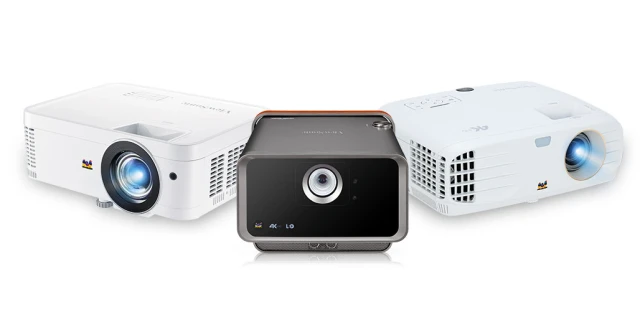

- Picture sharpness: Three-chip 3LCD projection avoids the rainbow flashes single-chip designs produce
- Colour accuracy: Colour brightness matches white brightness, so images never look washed out
- Setup and placement: A 1.62x zoom gives real freedom over where the projector actually sits
- Built-in smarts: Android TV is built in, so no streaming stick dangles off the back
- Built-in audio: The onboard speaker is loud enough to cover casual viewing without extras
- Lens flexibility: Horizontal and vertical correction handle rooms with awkward shelf positions
- Lamp life: A lamp rather than a laser means eventual replacement and dimming

- Picture sharpness: True 4K resolution rather than resolution assembled through pixel shifting
- Colour accuracy: Factory calibration means colours land accurately straight out of the carton
- Setup and placement: Vertical lens shift lets you raise the image without tilting the chassis
- Built-in smarts: Android TV handles streaming apps without any additional hardware attached
- Built-in audio: Twin speakers cover dialogue acceptably until a soundbar joins the setup
- Lens flexibility: A 1.3x zoom and lens shift together suit a dedicated cinema room
- Dark room: It wants a properly darkened room to show what it can do

- Picture sharpness: Triple laser output reaching 4100 ISO lumens, the brightest figure listed here
- Colour accuracy: An RGB laser engine covers far more of the colour gamut than lamps manage
- Setup and placement: Automatic keystone, focus and obstacle avoidance set the image up unaided
- Built-in smarts: Google TV is licensed properly, so the streaming apps all work natively
- Built-in audio: Harman Kardon speakers are genuinely usable for casual viewing sessions
- Laser speckle: Some viewers notice faint speckle in laser images on plain walls

- Picture sharpness: A laser light source keeps the image crisp without any focus drift over time
- Colour accuracy: Colour holds up well for a projector that fits inside a coat pocket
- Setup and placement: Autofocus and auto keystone mean pointing it roughly at a wall is enough
- Built-in smarts: Licensed Google TV includes the major streaming services natively
- Built-in audio: An 8W speaker doubles as a Bluetooth speaker when nothing is projecting
- Needs darkness: At 300 lumens it requires genuine darkness to look its best

- Picture sharpness: Sharp 4K images with the fastest response time of any projector ranked here
- Colour accuracy: Colour stays natural in game modes rather than turning lurid and oversaturated
- Setup and placement: A 1.1x zoom plus vertical keystone covers most typical mounting positions
- Built-in smarts: Enhanced gaming mode switches automatically when a console signal arrives
- Built-in audio: The internal speaker is adequate for casual play before a headset goes on
- Fan noise: The fan runs audibly in bright mode, noticeable during quiet scenes

- Picture sharpness: Sharp 4K images that scale cleanly from 65 inches up to 300 inches
- Colour accuracy: TriChroma laser reaches a far wider slice of the colour gamut
- Setup and placement: A motorised gimbal aims the image at walls or ceilings without any rigging
- Built-in smarts: Google TV handles apps, and auto screen fit squares the picture up
- Cost: It sits well above the mainstream picks for colour performance alone

- Picture sharpness: 4K sharpness backed by 4000 lumens, so daytime viewing stays perfectly workable
- Colour accuracy: Colour remains believable at high brightness rather than shifting toward blue
- Setup and placement: Auto keystone plus a 1.1x zoom handle most shelf and ceiling positions
- Built-in smarts: A 4.2ms response keeps console gaming feeling immediate and connected
- Built-in audio: Onboard speakers cover casual use until external audio gets connected
- Contrast: Deep blacks suffer next to the darker-room projectors ranked above
- Plain smarts: There is no full smart platform, so a streaming stick is needed

- Picture sharpness: Genuine 4K resolution from a chassis small enough to carry one-handed
- Colour accuracy: Laser colour stays consistent rather than shifting as a lamp would age
- Setup and placement: A rotating handle doubles as a stand, so aiming needs no tripod at all
- Built-in smarts: The webOS platform covers the major streaming services without extra hardware
- Brightness: At 500 lumens it needs a dark room despite the 4K resolution
- Speaker: Its small speaker struggles once the room holds more than a few people

- Picture sharpness: Clean 1080p images that suit casual viewing rather than critical film watching
- Colour accuracy: Colour handling inherits the tuning Samsung uses across its television range
- Setup and placement: A 180-degree cradle points it at walls or ceilings with no rigging required
- Built-in smarts: Tizen brings the full app catalogue plus a gaming hub for cloud play
- Resolution: It caps at 1080p, so fine detail trails the 4K models here
- Brightness: At 550 lumens ambient light washes the image out quickly

- Picture sharpness: Laser illumination at this level, where nearly every rival still uses lamps
- Colour accuracy: Colour is more stable than lamp projectors manage as they age over years
- Setup and placement: Autofocus and auto keystone remove the fiddly part of setting it up
- Built-in smarts: Google TV is included, so streaming needs no additional dongle at all
- Built-in audio: A 30W tuned speaker system is genuinely loud enough to skip a soundbar
- Native resolution: It accepts 4K signals but projects at 1080p natively
- Brand support: Long-term firmware and parts support is less certain here
All Ten Projectors in Detail
Each entry covers brightness in context, colour behaviour and the room the projector genuinely suits.
#1 · Editor's Choice
Epson Home Cinema 2350 Smart 4K Projector
Epson's three-chip approach is the reason this one leads. Single-chip projectors flash coloured artefacts that some viewers find impossible to ignore, and 3LCD sidesteps that entirely. Colour brightness matching white brightness matters just as much, because it means bright scenes keep their saturation rather than fading toward grey. A 1.62x zoom gives genuine freedom over placement, and Android TV removes the dangling stick. The lamp will dim eventually and need replacing, though, unlike the laser models further down. For a first proper projector, it is the safest pick.
The verdict: The most forgiving projector here for a normal living room, lamp replacement aside.
#2 · Runner-Up
BenQ W2720i 4K Smart Home Theater Projector
Where the Epson optimises for real living rooms, this one optimises for dark ones. True 4K resolution and factory colour calibration mean films look the way the colourist intended, provided you can control ambient light. Vertical lens shift is the underrated feature: raise the image without tilting the projector, avoiding the geometric distortion that keystone correction introduces. Draw the curtains and it outperforms everything above it on picture alone. Leave a window uncovered and the Epson looks better. Know which room you have before choosing.
The verdict: The picture-quality pick for a darkened room, and less suited to bright spaces.
#3 · Brightest Picture
Xgimi Horizon 20 Pro Triple Laser Projector
Brightness is the specification that decides whether a projector works before sunset, and 4100 ISO lumens puts this one comfortably ahead of everything else ranked. A triple laser engine also covers far more colour than a lamp can reach, so images look richer rather than merely brighter. Automatic setup handles keystone, focus and obstacles without input. The trade is laser speckle, a faint shimmer some viewers pick up on plain surfaces and others never notice. In a room with windows, this is the one to beat.
The verdict: The brightest and most colourful picture here, ideal for rooms you cannot darken.
#4 · Most Portable
Anker Nebula Capsule 3 Laser Portable Projector
Roughly the size of a drinks can, this is the projector that actually travels. A laser source keeps focus stable, the battery runs about two and a half hours, and licensed Google TV means Netflix works without sideloading anything. Setup amounts to putting it down and letting autofocus sort the rest. Three hundred lumens is the honest limit, though: this needs a genuinely dark room or a properly dark garden, and it will disappoint anyone expecting daytime use. Within that boundary, nothing else is this convenient.
The verdict: The most travel-friendly projector here, strictly for dark rooms and night gardens.
#5 · Best for Gaming
Optoma UHD35x 4K Gaming Projector
Four milliseconds of input lag at 1080p and 240Hz is the headline, and for anyone playing competitive games on a big screen it is decisive. Most projectors introduce enough delay to make fast titles feel disconnected, and this one simply does not. At 3600 lumens it also holds up in rooms with some ambient light, unlike the Capsule above. The fan is audible in bright mode, which quiet film scenes expose. As a console projector that also handles films, it is the obvious choice.
The verdict: The gaming projector to buy, provided a little fan noise does not spoil films.
#6 · Best Colour
Hisense C2 Ultra Triple Laser Smart Projector
Colour is where this one separates itself. Its TriChroma triple laser engine reaches far more of the visible spectrum than lamp projectors do, and the difference shows most in saturated reds and deep greens that usually look muted. The motorised gimbal is more than a gimmick: aim at a ceiling, a wall or a screen and it squares the image itself. Cost is the barrier, and the gimbal base makes it heavier than anything portable. For a colour-critical room, it justifies the outlay.
The verdict: The richest colour here, for buyers who will pay for it.
#7 · Best Bright Room
ViewSonic PX749-4K Bright Gaming Projector
Living rooms with windows defeat most projectors. Four thousand lumens is the answer to that problem, and this one stays genuinely watchable with daylight falling across the wall, which is exactly where the BenQ above would struggle badly. It doubles as a gaming display. A 4.2 millisecond response nearly matches the Optoma. Contrast is the compromise, since pushing brightness this hard lifts black levels and flattens night scenes. There is no smart platform either, so budget for a streaming stick alongside it.
The verdict: The brightest sensible option for a room you cannot darken, at some contrast cost.
#8 · Smallest 4K
LG CineBeam Q Compact 4K Laser Projector
Fitting true 4K into a 1.49kg cube is the trick here, and the rotating handle that doubles as a stand makes it genuinely grab-and-go. Laser illumination keeps colour consistent over years rather than drifting as lamps do. Resolution is the headline, but brightness is the catch: 500 lumens means darkness is required, so this competes with the Capsule rather than with the Xgimi. The speaker also runs out of steam with a few people in the room. As a portable 4K option, it stands alone.
The verdict: Real 4K in a genuinely portable shell, on the firm condition of a dark room.
#9 · Most Flexible Placement
Samsung The Freestyle Gen 2 Portable Projector
The swivel cradle is what makes this one different. Rotate it 180 degrees and the picture lands on the ceiling, which turns a bedroom into somewhere you can watch lying down. Automatic levelling and keystone square the image wherever it points. Tizen brings Samsung's full app catalogue plus cloud gaming without a console. Resolution stops at 1080p and 550 lumens washes out under lights, so this is a casual-viewing device rather than a cinema one. For bedrooms and camping, that suits it perfectly well.
The verdict: The most placement-flexible projector here, aimed at casual viewing rather than cinema.
#10 · Best Budget Laser
Yaber K3 Smart Laser Projector
Getting a laser light source at this level is unusual, and it matters more than the resolution headline. Lasers hold colour steadily for tens of thousands of hours where lamps fade and shift, so the picture you get in year three resembles year one. A 30W tuned speaker system is loud enough that many buyers will skip a soundbar entirely. Native resolution is 1080p despite 4K input support, and long-term brand support is less certain than with the established names. For the outlay, it is remarkably complete.
The verdict: A lot of projector for very little, provided native 1080p is honest enough for you.
How We Researched and Scored These Projectors
Published measurements from projector specialists and lab-testing sites form the backbone here, and we cross-checked each of those against manufacturer specifications and live retail listings ourselves. No darkened test room of ours sits behind this. Sixteen projectors entered our shortlist and ten survived, all of which we confirmed as currently sold.
- Brightness in context: measured output judged against the room each projector is realistically built for, not as a raw number.
- Colour capability: gamut coverage and whether colour brightness matches white brightness, which decides how washed out bright scenes look.
- Placement flexibility: throw ratio, optical zoom and lens shift, since these determine whether a projector fits your room at all.
- Smart platform: whether streaming apps are properly licensed and built in, or need a separate stick attached behind it.
- Running costs: lamp replacement against laser lifespan, which changes ownership costs considerably over five years.
Brightness and colour carried roughly thirty per cent each, placement flexibility about twenty five, with the smart platform and running costs splitting the remainder. We dropped three projectors because their listings resolved to discontinued models rather than current stock.
One integrity note: no manufacturer had input into this ranking, and no placement was paid for.
What to Look For in a Projector
Lumens are quoted in three incompatible ways, and manufacturers exploit the confusion. ANSI lumens follow a standardised measurement, ISO lumens use a similar modern standard, and unqualified lumens can mean almost anything a marketing department wants. When a projector quotes a huge number with no unit attached, treat it as fiction. Compare ANSI against ANSI, or you are not comparing anything.
Throw ratio decides whether a projector physically fits your room, and it is more important than resolution. A ratio of 1.5 means the projector sits roughly 1.5 times the screen width away from the wall. For a 100 inch image that is about three metres back. Short-throw models cut that distance sharply, and ultra short throw designs sit inches from the wall.
Light source changes the ownership cost more than the purchase price does. Lamps are cheaper up front and dim measurably over a few thousand hours, eventually needing replacement. Lasers cost more initially and typically run twenty thousand hours or more with little fade. Anyone watching daily should factor that in before comparing anything.
Finally, be realistic about ambient light. Projectors do not overpower daylight the way televisions do, and no amount of brightness fully compensates for an uncovered window at midday. If your viewing happens in a bright room during the day, either accept a brighter and more costly model or accept a compromised picture.
Who Needs a Projector (and Who Really Does Not)
Anyone wanting a picture beyond about 85 inches gains immediately, because televisions get disproportionately expensive past that size while projectors barely care. Film enthusiasts with a room they can darken should take our advice and look at the BenQ or the Hisense, both of which reward light control with picture quality no similarly priced television approaches.
Families in normal living rooms are better served by brightness than by contrast. The Epson and the Xgimi both stay watchable with lights on, and the ViewSonic handles daylight better still. Console players should weigh the Optoma against the ViewSonic, since both keep input lag low enough for fast games.
Travellers, campers and anyone projecting in a garden want the Capsule 3 or the Freestyle. Both trade resolution and brightness for portability, which is exactly the right trade when the alternative is carrying nothing at all.
Who should skip projectors? Anyone whose main viewing happens in a sunlit room during the day, and anyone who watches primarily alone on a screen under 65 inches. A television is simply the better tool in both cases, and it switches on faster.
Test Results
| Projector | Brightness | Resolution | Light source | Smart platform | Overall |
|---|---|---|---|---|---|
| Epson Home Cinema 2350 Smart 4K Projector | 2800 lumens | 4K via pixel shift | Lamp | Android TV | 9.7 |
| BenQ W2720i 4K Smart Home Theater Projector | 2500 ANSI lumens | True 4K | Lamp | Android TV | 9.6 |
| Xgimi Horizon 20 Pro Triple Laser Projector | 4100 ISO lumens | 4K | Triple laser | Google TV | 9.5 |
| Anker Nebula Capsule 3 Laser Portable Projector | 300 ANSI lumens | 1080p | Laser | Licensed Google TV | 9.2 |
| Optoma UHD35x 4K Gaming Projector | 3600 lumens | 4K UHD | Lamp | None fitted | 9.0 |
| Hisense C2 Ultra Triple Laser Smart Projector | 1600 ISO lumens | 4K | Triple laser | Google TV | 9.3 |
| ViewSonic PX749-4K Bright Gaming Projector | 4000 lumens | 4K UHD | Lamp | None fitted | 8.8 |
| LG CineBeam Q Compact 4K Laser Projector | 500 ANSI lumens | 4K UHD | Laser | webOS | 8.6 |
| Samsung The Freestyle Gen 2 Portable Projector | 550 ANSI lumens | 1080p | LED | Tizen | 8.4 |
| Yaber K3 Smart Laser Projector | 1000 ANSI lumens | 1080p native | Laser | Google TV | 8.2 |
Frequently Asked Questions
How many lumens do I actually need for my room
Match the number to your room rather than chasing the highest figure. Around 1000 ANSI lumens suits a fully darkened room, 2000 to 3000 handles a living room with curtains drawn, and beyond 3500 you can leave lights on. Check the unit too, because an unqualified lumens figure usually flatters the projector considerably.
Is a projector better than a large TV
For a big picture, yes, and for a small one, no. Past roughly 85 inches, televisions climb steeply in price while projectors barely change, so a 120 inch image costs far less this way. Televisions win on brightness, convenience and daytime viewing. Choose by screen size and by how much light your room lets in.
Can a projector work with the lights on
Some do, though none beat a television at it. The brightest models here stay watchable with lights on and curtains open, while the portable ones need genuine darkness. A grey ambient-light-rejecting screen helps considerably more than most buyers expect, often more than upgrading the projector itself would.
How far back does a projector need to sit for a 100-inch image
Multiply the screen width by the throw ratio. A projector with a 1.5 ratio needs roughly 1.5 times the image width in distance, so a 100 inch screen sits about three metres back. Short throw models shrink that considerably, and models with optical zoom give you a range rather than a fixed point.
What is throw ratio and why does it matter
For anyone watching most days, laser usually repays the difference. Lamps dim steadily and need replacing after a few thousand hours, with each replacement costing a meaningful fraction of the projector. Lasers typically run twenty thousand hours or more with little fade. Occasional viewers may never reach a lamp replacement at all.
Is laser worth the extra money over a lamp
A wall works, and a screen is better than most people expect. Painted walls have texture and a colour cast that a proper screen surface avoids, and grey ambient-light-rejecting screens improve contrast markedly in rooms with windows. Start with the wall, then add a screen once you know where the projector will live.
The Bottom Line
Epson takes this ranking because the Home Cinema 2350 suits the rooms people actually own, holding colour in imperfect light where rivals fade. The BenQ W2720i is the better buy if you can darken a room properly and want true 4K. Bright living rooms call for the Xgimi Horizon 20 Pro, gamers should take the Optoma UHD35x, and travellers want the Nebula Capsule 3. Measure your throw distance before ordering anything.
As an Amazon Associate I earn from qualifying purchases. See our affiliate disclosure for details. Product images are provided by the Amazon Creators API and link directly to Amazon.