10 Best Home Theater Systems of 2026, Researched & Ranked
Search for a home theater system and half the results are soundbars, which muddies a decision that is already complicated. This list sticks to multi-speaker systems, and says plainly where a single bar would serve you better. Our top pick is the Klipsch Reference R-26FA pack, whose floorstanding fronts and horn-loaded tweeters give films a scale no bar reaches.
Ranked below are ten systems judged on scale, dialogue anchoring, what actually arrives in the carton and how realistic each is to install. They run from wireless sets needing no speaker cable through to a nine-channel layout for large open rooms, with a guide that decodes the channel numbers.
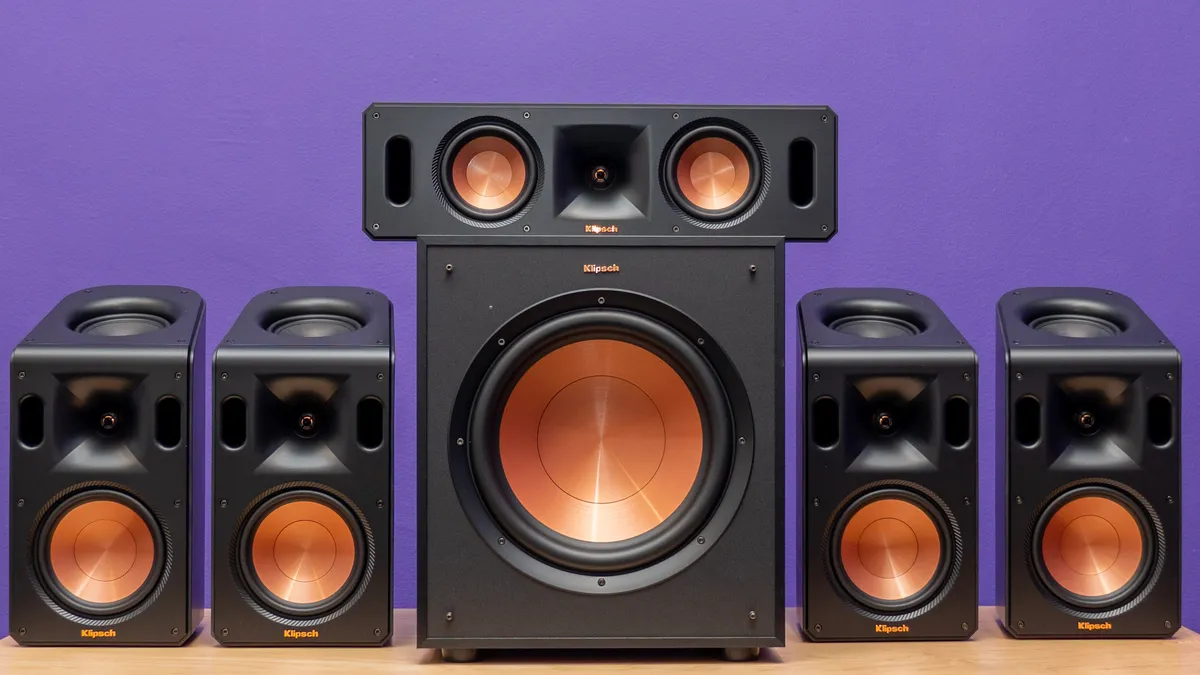

- Movie scale: Floorstanding fronts with upfiring drivers give effects real physical scale
- Dialogue anchoring: A matched centre channel keeps every line of dialogue tied to the screen
- Installation effort: Speaker cable and stands are the only extras beyond a receiver
- Music ability: Horn-loaded tweeters make this set genuinely enjoyable for stereo music
- Room filling: A 10-inch powered subwoofer covers a medium room without strain
- Upgrade headroom: Adding rear height speakers later expands it toward a full Atmos layout
- Receiver needed: You must budget for an amplifier, which the package leaves out
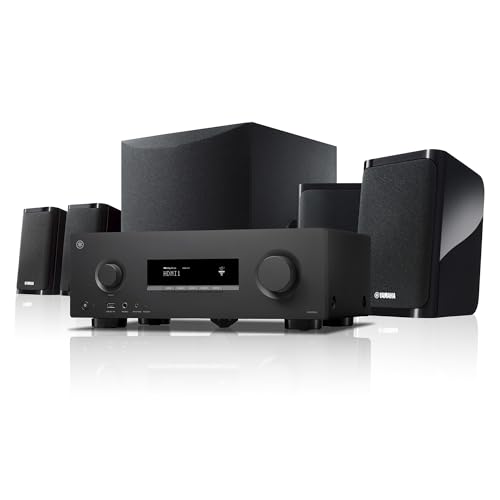
- Movie scale: Five matched speakers and a subwoofer arrive with an amplifier already included
- Dialogue anchoring: The dedicated centre channel is tuned to match the fronts exactly
- Installation effort: One carton contains everything, so a first surround setup takes an evening
- Music ability: Yamaha's amplifier heritage shows in how naturally stereo music plays
- Room filling: YPAO calibration measures the room and corrects output without manual work
- Upgrade headroom: The receiver has spare channels, so extra speakers can be added later
- Speaker size: The compact satellites cannot move air the way floorstanders do
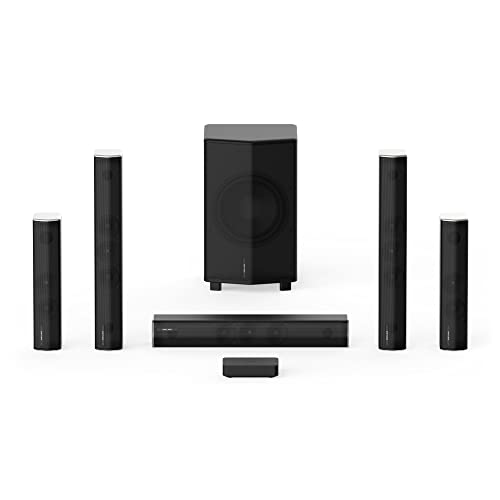
- Movie scale: Five discrete wireless speakers produce genuine surround without any speaker cable
- Dialogue anchoring: A proper centre channel keeps dialogue distinct rather than merely louder
- Installation effort: Only power cables run to each speaker, so no cable channels are needed
- Music ability: The 24-bit wireless link avoids the compression cheaper wireless kits use
- Room filling: A 10-inch subwoofer gives the set weight in a medium-sized room
- Power sockets: Every speaker still needs a mains socket within reach of it

- Movie scale: Sixteen drivers across four panels generate scale from surprisingly small boxes
- Dialogue anchoring: Phantom channel processing places dialogue precisely at the screen position
- Installation effort: Four flat panels mount on walls like picture frames, hiding the system away
- Music ability: Music benefits from the same spatial mapping rather than sounding processed
- Room filling: Room mapping measures speaker positions and adapts the output to them
- No subwoofer: A subwoofer is a separate purchase, and the panels want one

- Movie scale: Compact satellites paired with a genuinely serious nine-channel receiver
- Dialogue anchoring: Dirac Live room correction is a step above the calibration most packages use
- Installation effort: Everything arrives together, wired conventionally with ordinary speaker cable
- Music ability: The receiver handles stereo music properly rather than treating it as an afterthought
- Room filling: Four spare amplifier channels leave room to grow toward a full Atmos layout
- Satellite limits: Small satellites give ground on scale against floorstanding rivals
- Complexity: A nine-channel receiver has a menu system that rewards patience

- Movie scale: Two dedicated height speakers rather than the simulated effects budget rivals use
- Dialogue anchoring: A centre channel is included, which many cheap packages quietly omit
- Installation effort: Keyhole mounts on every satellite make wall placement straightforward
- Music ability: The set handles music acceptably given how little it costs
- Room filling: An 8-inch powered subwoofer adds real weight beneath the satellites
- Amplifier extra: An amplifier is required, and it is not part of this package
- Small drivers: The compact satellites give ground on scale in bigger rooms

- Movie scale: Five timbre-matched satellites keep effects consistent as they pan between speakers
- Dialogue anchoring: A dedicated centre speaker handles dialogue rather than leaving it to the fronts
- Installation effort: Wall brackets are included, so mounting needs no additional hardware
- Music ability: Vocals and acoustic music sound natural despite the tiny cabinets
- Room filling: The compact size suits rooms where larger speakers would dominate visually
- No subwoofer: There is no subwoofer, so bass needs a separate purchase
- Output limits: Small drivers run short of headroom in genuinely large rooms
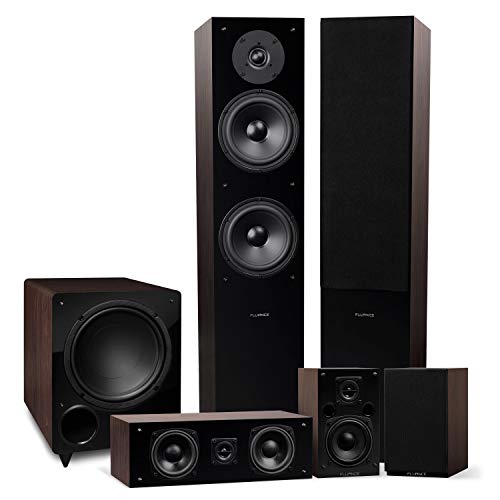
- Movie scale: Three-way floorstanding fronts give music the scale that satellites cannot reach
- Dialogue anchoring: Silk dome tweeters keep dialogue smooth rather than sharp during long films
- Installation effort: Gold-plated binding posts accept proper speaker cable rather than spring clips
- Music ability: Real wood veneer cabinets control resonance in a way plastic simply does not
- Amplifier cost: An amplifier is required and adds meaningfully to the total
- Size: Floorstanding fronts need floor space that smaller rooms cannot spare
- Assembly: Wiring five speakers properly takes an afternoon of careful work

- Movie scale: Two 10-inch subwoofers and thirteen outputs fill rooms that defeat smaller systems
- Dialogue anchoring: A dedicated centre keeps dialogue intelligible even at high playback volumes
- Installation effort: No receiver is needed, so setup avoids the usual amplifier decisions entirely
- Music ability: Quad surrounds with upfiring drivers wrap sound around large seating areas
- Sheer size: Two subwoofers and four surrounds demand a genuinely large room
- Music: It is voiced for films, and stereo music sounds comparatively blunt
- Cable runs: The surround speakers are wired, so cable routing still applies
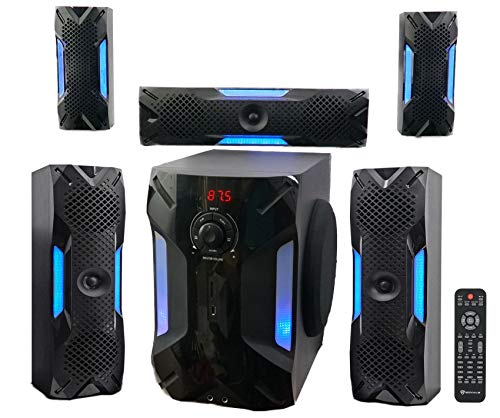
- Movie scale: Five satellites and a subwoofer with amplification already built into the system
- Dialogue anchoring: A centre channel is included, which pushes dialogue ahead of television speakers
- Installation effort: Optical, coaxial and Bluetooth inputs cover nearly any television made recently
- Music ability: Bluetooth makes it usable for background music without switching the screen on
- Modest fidelity: Detail and refinement fall well short of everything above it
- Small drivers: The satellites thin out noticeably when pushed to higher volumes
- Basic controls: Setup options are minimal, with no room correction available
All Ten Home Theater Systems in Detail
Each entry covers scale, dialogue handling and exactly what arrives in the box, which varies more here than in any other category.
#1 · Editor's Choice
Klipsch Reference R-26FA 5.1 Home Theater Pack
Klipsch horn-loaded tweeters are divisive among audio people and unbeatable for films, because they throw detail forward with an energy domed tweeters rarely match. This pack pairs floorstanding fronts carrying upfiring height drivers with a matched centre and a 10-inch subwoofer. Scale is what you notice first. The catch sits outside the carton, though: there is only a speaker package here, so budget for an amplifier before comparing this against anything that includes one. Do that and it is the most capable system ranked here.
The verdict: The best-sounding package on this list, once you have added a receiver to drive it.
#2 · Runner-Up
Yamaha YHT-4970U 5.1 Home Theater System
Everything needed arrives together, and that matters more than enthusiasts admit. A Yamaha receiver, five matched speakers and a powered subwoofer in one carton removes every compatibility question a first-time buyer would otherwise face. YPAO calibration then measures the room and corrects for it automatically. The receiver also passes 4K120 and 8K, so it will not bottleneck a modern console. Satellites cannot move air the way the Klipsch floorstanders do, which is the honest limit here. As a complete starting system, it is hard to fault.
The verdict: The most complete package for a first surround system, amplifier included.
#3 · Best Wireless
Enclave CineHome Pro Wireless Surround System
Running speaker cable to the back of a room is what stops most people building surround, and this system removes that job entirely. Five WiSA-certified speakers receive uncompressed 24-bit audio wirelessly from a small hub, with no receiver in the rack at all. Setup takes minutes rather than a weekend. Each speaker still needs mains power, so five sockets remain a genuine planning constraint, particularly behind a sofa. For renters and anyone who cannot drill walls, no other system here comes close.
The verdict: Real discrete surround with no speaker cable, provided you can reach five sockets.
#4 · Premium Pick
Sony Bravia Theater Quad Wireless Speaker System
Four flat panels and a control box replace an entire speaker layout here, and the processing is what makes it work. Spatial mapping measures where each panel actually sits, then synthesises up to twelve phantom channels from sixteen drivers. Effects appear in places no speaker occupies. Panels mount flush like picture frames, which solves the aesthetic objection that kills most surround plans. No subwoofer is included, though, and these panels genuinely want one for films. It is the most elegant solution on this list.
The verdict: The most discreet way to get convincing surround, with a subwoofer bought separately.
#5 · Best Complete System
Energy RC-Micro 5.1 System with Onkyo Receiver
Most packages pair decent speakers with a weak amplifier. This one inverts that, putting compact Energy satellites in front of an Onkyo receiver rated at 250W per channel with Dirac Live correction on board. Dirac is meaningfully better than the automatic calibration bundled with cheaper systems, and it shows in how even the sound is across seating positions. Satellites cannot match floorstanders for scale, and the receiver menus reward patience. As a foundation to grow from, it is the smartest buy here.
The verdict: The best long-term foundation, because the receiver outlasts the speakers it ships with.
#6 · Best Budget Atmos
Monoprice Premium 5.1.2 Channel Theater System
Dedicated height speakers at this level are rare, and that is what lifts this above the crowd of cheap satellite sets. Two upward-facing speakers handle Atmos properly rather than simulating it through processing, and a real centre channel keeps dialogue anchored. An 8-inch subwoofer provides weight the satellites cannot. You will need a receiver, so the true cost is higher than the sticker suggests. Compared against the Rockville further down, though, this is a considerably more serious system.
The verdict: Genuine Atmos height channels for very little, once a receiver joins the setup.
#7 · Best for Small Rooms
Polk Audio TL250 Compact Five-Speaker System
Small rooms punish large speakers, and this five-pack answers that directly. Timbre-matched satellites keep effects consistent as sound pans across the front, which is exactly where mismatched speakers give themselves away. A dedicated centre handles dialogue properly. Two things are missing: there is no subwoofer and no receiver, so this is a component rather than a complete system. Bass will need adding. In a flat or a box room where the Klipsch floorstanders would overwhelm everything, it makes far more sense.
The verdict: The right speaker set for small rooms, though a subwoofer and receiver are extra.
#8 · Best for Music
Fluance Elite High Definition 5.1 Speaker System
Silk dome tweeters are the giveaway that this set was voiced for music first. Films still land well, but the smoothness that keeps long viewing sessions comfortable is the same quality that makes acoustic recordings convincing. Three-way floorstanding fronts move real air, and wood veneer cabinets control resonance that plastic enclosures pass straight through. A receiver is required, the fronts need floor space, and wiring it up takes an afternoon. Households that listen as much as they watch should start here.
The verdict: The pick for anyone who plays music as often as films, receiver aside.
#9 · Best for Large Rooms
Nakamichi Shockwafe 9.2.4 Surround Sound System
Open-plan rooms defeat most surround systems, because the sound simply dissipates before it reaches the sofa. Two 10-inch subwoofers and thirteen discrete outputs answer that with brute capability. Four surround speakers carry their own upfiring drivers, so height effects arrive from behind as well as in front. No receiver is required. In a smaller room the whole thing is absurd, music sounds blunt next to the Fluance set, and the surrounds still need cable runs. For a big space, it works.
The verdict: Built for large open rooms, and thoroughly excessive in anything smaller.
#10 · Best Value Pick
Rockville HTS56 Bluetooth Surround Sound System
Every ranking needs an honest entry point, and this is it. Five satellites, an 8-inch powered subwoofer and built-in amplification mean no receiver purchase at all, which makes the total outlay lower than several speaker-only packages listed above. Optical, coaxial and Bluetooth inputs cover almost any television. Fidelity falls well short of the Klipsch or Fluance sets, the satellites thin out when pushed, and there is no room correction. Judged against television speakers rather than against hi-fi, it is a real upgrade.
The verdict: The cheapest route to genuine five-channel surround, with fidelity limits to match.
How We Researched and Scored These Home Theater Systems
Published testing from hi-fi titles and consumer publications underpins this ranking, and we checked every claim against manufacturer specifications and live retail listings. No listening room of ours sits behind it. Sixteen systems entered our shortlist and ten survived, each confirmed as currently sold as a complete package rather than as individual speakers.
- Scale and impact: whether a system can fill its intended room, judged by driver size and subwoofer capability rather than by quoted wattage.
- Dialogue anchoring: the presence and quality of a dedicated centre channel, since that is what keeps speech tied to the screen.
- What actually arrives: whether an amplifier, a subwoofer and rear speakers are included or must be bought afterwards.
- Installation reality: cable runs, mains sockets and floor space, which decide whether a system is practical in your home.
- Music ability: stereo performance, because most of these systems will play far more music than films.
Scale and dialogue carried roughly thirty per cent each, with box contents and installation about twenty per cent apiece and music breaking ties. Six candidates were dropped outright: several resolved to single speakers rather than packages, and others were no longer listed at all.
One integrity note: no manufacturer had input into this ranking, and no placement was paid for.
What to Look For in a Home Theater System
Channel notation decodes easily once you know the pattern. The first number counts speakers arranged around you at ear level, the second counts subwoofers, and the third counts height channels aimed upward or mounted overhead. So 5.1.2 means five surrounding speakers, one subwoofer and two height drivers, while 9.2.4 means nine, two and four respectively.
Whether a receiver is included changes the real price more than anything else on the specification sheet. Four systems here ship without an amplifier, and a capable one adds a meaningful sum to the total. Two need no receiver at all because amplification is built in. Compare complete costs rather than package prices, or the cheapest option stops being cheapest.
Installation is where most surround plans quietly die. Wired systems need cable from the amplifier to every speaker, including the two behind your sofa, which usually means lifting carpet or fitting trunking. Wireless systems remove that work but still need a mains socket at each speaker. Neither approach is effort-free, so decide which constraint your home can absorb before choosing.
Finally, match the system to the room rather than to your ambition. A 9.2.4 layout with two subwoofers is genuinely excessive in a small lounge, where it will overwhelm the space and annoy neighbours. A compact satellite set in a large open-plan room will sound thin no matter how carefully you position it.
Who Needs a Home Theater System (and Who Really Does Not)
Anyone building a dedicated film room should be here rather than looking at soundbars. Discrete speakers placed around a room produce effects that genuinely originate behind and above you, and no single bar fully matches that. The Klipsch pack and the Fluance set both reward a room you can arrange around the screen.
People who want surround without construction work should look at the wireless options. The Enclave system needs no speaker cable at all, and the Sony panels mount flat on a wall like pictures. Both suit renters and anyone unwilling to lift floorboards for a hobby.
First-time buyers are best served by packages that include amplification. The Yamaha system and the Energy and Onkyo combination each remove every compatibility question, while the Rockville set does the same at a much lower outlay.
Who should skip all of this? Anyone in a flat with thin walls or shared floors, where subwoofers create more conflict than enjoyment. Anyone unwilling to place five speakers and route power to them is genuinely better served by a good soundbar, which does most of this with one box and one cable.
Test Results
| System | Channels | Receiver | Subwoofer | Wiring | Overall |
|---|---|---|---|---|---|
| Klipsch Reference R-26FA 5.1 Home Theater Pack | 5.1 with height | Not included | 10-inch powered | Wired | 9.7 |
| Yamaha YHT-4970U 5.1 Home Theater System | 5.1 | Included | Powered, included | Wired | 9.6 |
| Enclave CineHome Pro Wireless Surround System | 5.1 | Not required | 10-inch included | Wireless | 9.4 |
| Sony Bravia Theater Quad Wireless Speaker System | 4.0.4 with mapping | Control box included | Sold separately | Wireless | 9.3 |
| Energy RC-Micro 5.1 System with Onkyo Receiver | 5.1 on 9 channels | Onkyo, included | Included | Wired | 9.1 |
| Monoprice Premium 5.1.2 Channel Theater System | 5.1.2 | Not included | 8-inch powered | Wired | 8.8 |
| Polk Audio TL250 Compact Five-Speaker System | 5.0 | Not included | Sold separately | Wired | 8.5 |
| Fluance Elite High Definition 5.1 Speaker System | 5.1 | Not included | Included | Wired | 8.7 |
| Nakamichi Shockwafe 9.2.4 Surround Sound System | 9.2.4 | Not required | Two 10-inch | Wired surrounds | 8.9 |
| Rockville HTS56 Bluetooth Surround Sound System | 5.1 | Built into subwoofer | 8-inch powered | Wired | 8.0 |
Frequently Asked Questions
Do I need an AV receiver for surround sound
Usually yes, though three systems here avoid it. A receiver decodes surround formats, powers passive speakers and switches your sources, and any package sold as speakers alone needs one. Systems with amplification built into the subwoofer, or wireless sets with a hub, skip that requirement entirely and cost less overall as a result.
Is 5.1 or 7.1 better in a small room
In a small room 5.1 is usually the better choice. Adding rear channels only helps when there is genuine distance between the side and rear positions, and in a compact lounge those speakers end up almost touching. Spend the difference on better speakers or a stronger subwoofer instead, both of which you will actually hear.
What do the numbers in 5.1.4 actually count
Three separate counts, read left to right. The first is speakers around you at ear level, the second is subwoofers, and the third is height channels firing upward or mounted overhead. A 5.1.4 layout therefore means five surrounding speakers, one subwoofer and four height channels, which is a substantial installation.
What does Dolby Atmos add to a home theater system
It adds a vertical dimension, so sound can come from above rather than only around you. Rain, helicopters and aircraft are the obvious cases. Height comes either from speakers firing at the ceiling or from proper overhead mounting, and the effect depends heavily on having a flat ceiling of ordinary height to reflect from.
Where should surround speakers actually go
Slightly behind and to the side of the seating position, ideally just above ear height when seated. Directly behind the sofa is a common mistake, because it puts effects too close to your head and collapses the surround field. Aim them toward the listening position rather than straight across the room.
Is a wireless surround system as good as a wired one
Close, and the gap keeps narrowing. Certified wireless systems carry uncompressed 24-bit audio with no audible penalty, which is what the Enclave set uses. The real trade is not sound quality but power, because every wireless speaker still needs a mains socket. Cheaper wireless kits that compress the signal are a different matter.
The Bottom Line
The Klipsch Reference pack wins because it produces a scale of sound that no single bar approaches, provided you are willing to buy an amplifier for it. Anyone who wants everything in one carton should take the Yamaha system instead, which removes every compatibility question. Renters and anyone who cannot run cable should look at the Enclave wireless set. If none of that appeals, a good soundbar is the honest answer, and there is no shame in it.
As an Amazon Associate I earn from qualifying purchases. See our affiliate disclosure for details. Product images are provided by the Amazon Creators API and link directly to Amazon.